Thursday, April 16, 2015

Critical Responses to John Osborne's LUTHER


There are many different reviews of John Osborne's play Luther including one by theatre critic Charles Marowitz and one by theatre scholar David Graver. In Marowitz's review he concentrates on how Luther relates to Osborne's other plays, specifically Look Back in Anger, The Entertainer and The World of Paul Slickey. He focuses on the idea that this is not a departure, as he calls it, or a work outside the realm of Osborne's writing styles. He continues to talk about the temperature of the play as being just as hot as his earlier works but that the heat comes from a different place (the early place sought social justice while Luther speaks from bitterness and difference of opinion). He also compares the way the piece uses tableaus and images through the play to the work of Brecht.


Graver also compares Luther to the work of Brecht and his ideas of epic theatre but claims that if we make that comparison then we must also declare the play a failure (based on the ideals of Brechtian dramaturgy). This mostly comes from the lack of historical representation of the play's main character, Martin Luther. In addition to the misreporting of facts, Graver also accuses Osborne of selling the titular character short by not highlighting his "intellectual powers". He goes on to say that this puts increasingly problematic limitations on his protagonist.   

A Subject of Scandal and Concern: The Case of Colin Shaw

In August of 1961 John Osborne's second wife, actress Mary Ure Osborne, gave birth to his son Colin Murray Osborne. At the time the married couple were in the middle of increasingly hostile divorce proceedings and through these proceedings it was revealed that there was more good chance that John Osborne was not the father of Colin. He seemed to believe that the real father was actor Robert Shaw. Theses beliefs seemed to be validated when Ure married Shaw almost immediately after the divorce was finalized (and then Shaw adopted Colin). Even though signs point to Osborne doubting the paternity of his son, he acted as the boy's father throughout the divorce process up until the adoption. Many people believe the reason for this was that Osborne wanted to get through the divorce proceedings as quickly as possible and then marry his third wife, Penelope Gilliatt. After Shaw died at the young age of 55 of a heart attack, rumor has it that Osborne's wife at the time (his fifth) suggested he finally meet the 17 year old. John quickly turned down this proposal. Oddly enough, if Colin was indeed Shaw's biological son then he ended up adopted his own son.


John Osborne: A Background

In 1929 John James Osborne was born in Fulham, London to a commercial artist and barmaid. When he was only 11 his father died and then he was sent to boarding school (he was later expelled for getting into a physical confrontation with a teacher). By this time World War II was over and he had dodged serving in the military. His first jobs out of school were as a journalist at several different trade magazines. At the age of 19 he acted for the first time and only a year later collaborated on his first play. In 1956 his masterpiece Look Back in Anger was performed for the first time at the Royal Court Theatre. After the success of this work the Evening Standard named Osborne the most promising playwright of the year. He then became exceedingly prolific by today's standards, churning out: The Entertainer (1957), Epitaph for George Dillon (1958), The World of Paul Slickey (1959), A Subject of Scandal and Concern (1960), Luther (1961) and Plays for England: The Blood of the Bambergs (1962). He wrote more plays as well but not one a year like he did over this six year period. The influence of German playwright and theatre practitioner Bertolt Brecht is evident in his work, especially in his sixth play Luther. In addition to plays for the stage, he wrote several scripts for special presentations on the BBC. He also was known for adapting and abridging works by Wilde, Ibsen and Strindberg. 

Monday, April 13, 2015

John Osborne (1929 - 1994)

John Osborne in 1991
Osborne in (circa) 1982
Osborne in 1971

John and his fourth wife Jill Bennett in 1969

  
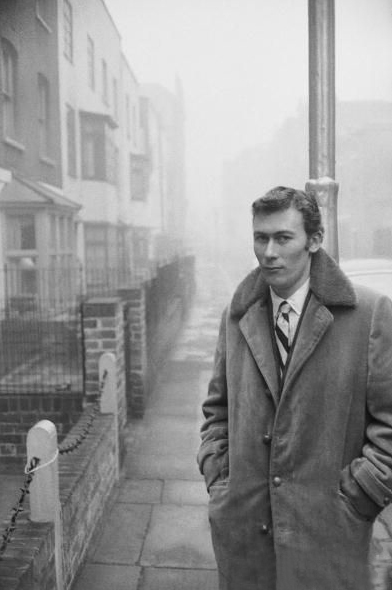
John Osborne in Chelsea, 1958

Osborne poses for a book cover in 1956

  
A very young John Osborne.